
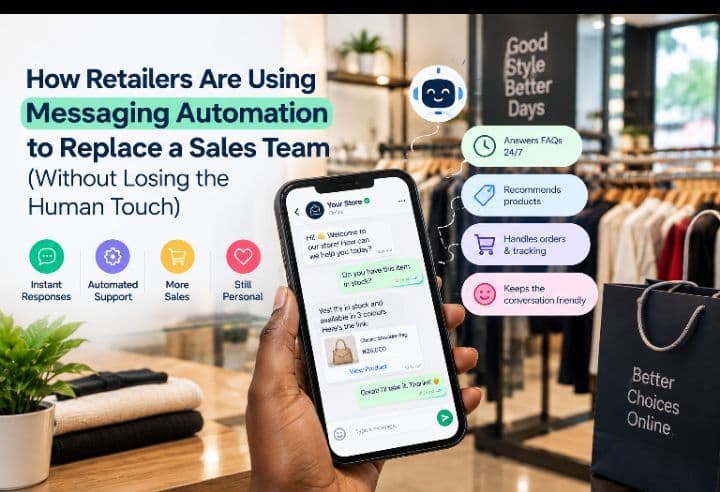
How Retailers Are Using Messaging Automation to Replace a Sales Team (Without Losing the Human Touch)
September 18, 2026 · by Kabirat O.
Can Automation Really Replace a Retail Sales Team?
Retail businesses receive customer questions every day. Customers want to know if a product is available, how much it costs, what sizes are in stock, when an order will arrive, and how they can make a purchase. Handling all these conversations manually can become difficult as a business grows. This is where “messaging automation” comes in. Instead of having sales staff respond to every routine question, retailers can use automated messaging systems to handle common conversations, recommend products, collect customer information, and move buyers through the sales process. The goal is not to make customers feel like they are talking to a robot. The goal is to automate repetitive work while allowing human staff to focus on conversations that actually need a human response.
What Is Messaging Automation?
Messaging automation is the use of software to automatically send and respond to customer messages based on predefined rules, customer actions, or artificial intelligence.
For retailers, this can include automated conversations through channels such as websites, WhatsApp, Instagram, Facebook Messenger, SMS, and other messaging platforms. A messaging automation system can help businesses:
- Answer frequently asked questions
- Recommend products
- Check customer needs
- Qualify potential buyers
- Collect customer details
- Send order updates
- Follow up with interested customers
- Direct complex questions to staff
- Support customers outside business hours
This means a retailer does not have to rely on a sales representative to answer every basic question.
Why Retailers Are Turning to Messaging Automation
Customers expect quick responses. If someone sends a message asking about a product and waits several hours for a reply, they may move to another retailer that responds faster. This becomes even more challenging for businesses receiving hundreds or thousands of customer messages. Hiring more sales representatives can increase costs, while expecting a small team to handle every conversation can lead to slow responses and missed opportunities. Messaging automation provides another option. It can handle repetitive conversations automatically while sales staff focus on customers who need more detailed assistance.
Automate the Questions Customers Ask Every Day
Retailers often receive the same questions repeatedly.
Examples include:
- “How much is this?”
- “Is size 40 available?"
- “Do you deliver to Lagos?”
- “How long does delivery take?”
- “What colours do you have?”
These questions do not always require a sales representative. An automated messaging system can provide the answer immediately using information from the retailer's product catalogue or knowledge base. This saves time for both customers and employees.
Recommend Products Based on What Customers Want
Product recommendations are another area where messaging automation can support sales. Instead of making customers search through hundreds of products, an automated conversation can ask simple questions.
For example:
Customer: I need a black dress for a wedding.
Automation: What size do you need?
Customer: Size 12.
Automation: Do you prefer a long or short dress?
The system can then show relevant products based on the customer's answers. This creates a more personalized shopping experience without requiring a salesperson to manually guide every customer.
Qualify Customers Before a Sales Representative Steps In
Not every person who sends a message is ready to buy. Some are simply looking for information. Others may be comparing prices, while some already know what they want. Messaging automation can ask qualifying questions before sending a conversation to a human sales representative.
For example:
- What product are you interested in?
- What quantity do you need?
- What is your preferred budget?
- When do you need it?
- Where should the order be delivered?
By the time a sales representative joins the conversation, they already understand what the customer needs. This can make the sales process faster and more efficient.
Follow Up Without Making Customers Feel Forgotten
Many customers show interest without completing a purchase. Someone may ask about a product today and say they will come back later. Without a follow-up system, that potential sale can easily disappear. Messaging automation can send appropriate follow-up messages based on customer actions.
For example:
“Hi, you asked about the black sneakers yesterday. They are still available in your size. Would you like us to reserve a pair for you?”
The important part is timing and relevance. Automation should not send customers endless promotional messages. Follow-ups should provide useful information and give customers a clear option to continue the conversation.
Keep Customers Updated After They Buy
The sales process does not end after payment. Customers may want to know whether their order has been confirmed, shipped, or delivered. Automated messages can provide updates such as:
- Order confirmation
- Payment confirmation
- Shipping notification
- Delivery updates
- Appointment reminders
- Returns information
This reduces the number of routines “Where is my order?” messages that sales or customer service staff have to answer manually.
Be Available Outside Business Hours
A customer may discover a product at 11 p.m. They may not want to wait until the next morning before asking a simple question. Messaging automation allows retailers to provide basic assistance outside normal business hours. For example, an automated assistant can answer questions about:
- Product availability
- Prices.
- Store hours
- Delivery
- Returns
- Payment options
- Order status
If the question requires human assistance, the system can collect the customer's details and notify the appropriate team. This means customers can still receive support even when the sales team is offline.
Automation Should Not Mean Removing Humans
This is where many businesses get it wrong. The goal should not be to automate every customer interaction. Some conversations need empathy, judgment, negotiation, or detailed product knowledge.
For example, a customer who received the wrong product may be frustrated. A fully automated response may make the situation worse. Instead, automation should recognize when a conversation needs human attention. A good system can use a simple process:
Automate → Identify → Escalate → Human Response
The automation handles routine questions. When the conversation becomes more complex, it passes the customer to a human representative with the relevant conversation history. This creates a balance between efficiency and personal service.
How Retailers Can Create a Human-Like Automated Experience
Automation does not have to sound robotic. Businesses can make automated conversations more natural by:
- Using Simple Language
- Avoid complicated technical wording.
Customers should understand the message immediately.
Remembering Customer Information
If a customer has already provided their name, product preference, or order number, they should not have to repeat the same information unnecessarily.
Giving Customers Options
Instead of sending long blocks of text, provide clear options such as:
1. Check product availability
2. Track my order
3. Speak to an agent
Knowing When to Stop Automating
When a customer asks a complicated question or becomes frustrated, the conversation should be transferred to a human.
The best automation knows when not to automate.
The Role of AI in Retail Messaging
Artificial intelligence is making messaging automation more flexible. Traditional automation often depends on fixed rules.
For example:
If a customer says “delivery” → Send delivery information.
AI-powered systems can understand variations in how customers ask questions.
A customer might say:
“How long before my order gets here?”
Another might ask:
“When should I expect delivery?”
The wording is different, but the meaning is similar. AI can help businesses understand these variations and provide more relevant responses. However, retailers should still make sure that automated systems use accurate product, pricing, inventory, and order information.
What Retailers Should Automate First
Businesses do not need to automate everything at once. A better approach is to start with repetitive tasks that take up the most staff time.
Good starting points include:
- Frequently asked questions
- Product information
- Order tracking
- Appointment or delivery reminders
- Lead qualification
- Customer follow-ups
- Basic returns information
After these processes are working properly, retailers can gradually introduce more advanced automation.
Common Mistakes to Avoid
Messaging automation can improve customer service, but poor implementation can have the opposite effect.
Making It Impossible to Reach a Human
Customers should always have a clear way to request human assistance when necessary.
Giving Incorrect Information
An automated system that provides outdated prices, product details, or delivery information can damage customer trust.
Sending Too Many Messages
Frequent promotional messages can annoy customers and make them ignore future communication.
Automating Sensitive Conversations
Complaints, complicated returns, payment problems, and unusual customer requests may require human attention.
Focusing Only on Automation
The purpose of automation is to improve the customer experience and business operations, not simply to reduce the number of employees involved.
How Messaging Automation Can Improve Retail Sales
When implemented properly, messaging automation can support different stages of the customer journey.
A potential customer discovers a product.
The automated system answers their questions.
It recommends relevant products.
The customer provides their details.
The system directs them toward purchase.
After the purchase, automated updates keep them informed.
If the customer has a complex issue, a human representative takes over.
This creates a connected sales and customer service process instead of treating every message as a separate conversation.
Key Insight
The best retail messaging automation does not remove the human touch. It removes unnecessary manual work.
Sales representatives should spend less time answering repetitive questions and more time helping customers make decisions, solving problems, and closing valuable sales.
That is where automation becomes useful.
Frequently Asked Questions(FAQs)
Can messaging automation replace a retail sales team?
Messaging automation can handle many repetitive sales and customer service tasks, but it does not have to completely replace human sales staff. The most effective approach is to automate routine conversations and allow employees to handle complex or high-value interactions.
What can retailers automate through messaging?
Retailers can automate FAQs, product recommendations, lead qualification, order updates, delivery information, customer follow-ups, appointment reminders, and other repetitive conversations.
Does messaging automation make customer service less personal?
Not necessarily. When properly designed, automation can make customer service faster while still allowing customers to reach a human when needed. Personalization, customer context, and human escalation are important.
Can AI messaging automation increase sales?
It can support sales by responding quickly, recommending relevant products, qualifying leads, and following up with interested customers. However, results depend on the quality of the automation, product information, customer experience, and overall sales process.
Should every customer conversation be automated?
No. Routine questions are good candidates for automation, while complaints, complex requests, negotiations, and sensitive issues may require human support.
How should a retailer start with messaging automation?
Start by identifying repetitive customer questions and sales tasks that take up significant staff time. Automate those processes first, measure the results, and gradually expand the system.
Final Insight
Retail is becoming more conversational. Customers want quick answers, useful recommendations, and easy ways to buy. At the same time, businesses need to control costs and help their sales teams work more efficiently. Messaging automation can help retailers achieve both goals. The key is not to replace every human interaction with a bot. It is to let technology handle repetitive tasks while people focus on conversations where human judgment actually matters.
When automation and human support work together, retailers can respond faster, serve more customers, and create a better buying experience without making customers feel like they are talking to a machine.
Digisperts helps businesses use technology, automation, and digital solutions to improve how they operate and serve their customers.
Explore Digisperts:
https://www.digisperts.com/
Your customers want fast answers. Your team should have time to give the answers that actually need a human.