
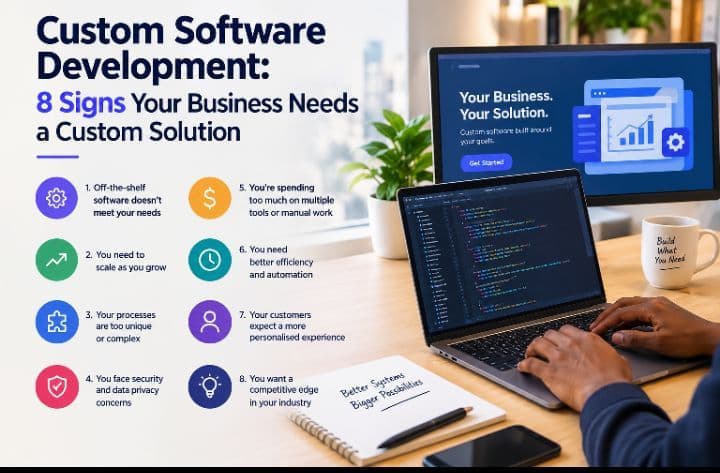
Custom Software Development: 8 Signs Your Business Needs a Custom Solution
· by Kabirat O.
Is Your Business Outgrowing Its Current Software?
The software that worked for your business two years ago may not be enough today. As a business grows, its processes become more complex. You may have more customers, more employees, more data, and more systems to manage. Eventually, your team may start creating spreadsheets, manual workarounds, or using several different tools just to complete one process. This is often a sign that your business has outgrown its current software.
Custom software development allows businesses to build technology around their specific workflows, customers, and growth plans instead of changing their operations to fit a generic application.
But how do you know when custom software is actually worth the investment?
Here are eight signs to look for.
What Does Custom Software Development Mean?
Custom software development is the process of designing and building software specifically for the needs, processes, and goals of a particular business or organization.
Unlike off-the-shelf software, which is designed for a broad market, custom software can be built around your company's unique requirements.
This could include:
- Custom web applications
- Mobile applications
- Internal business platforms
- Customer portals
- Inventory systems
- Enterprise software
- Data dashboards
- Business automation systems
- Software integrations
The goal is not simply to build something from scratch. It is to solve a business problem in a way that existing software cannot adequately handle.
Digisperts provides custom software development services for businesses looking for scalable applications built around their specific challenges:
https://www.digisperts.com/what-we-do/software-development
When Off-the-Shelf Software Stops Being Enough
Off-the-shelf software is not automatically bad.
In fact, it can be the right choice for many businesses. If an existing application solves your problem at a reasonable cost and does not create major limitations, there may be no reason to build something custom.
The problem starts when your business has to constantly work around the limitations of the software.
You may find yourself asking:
- Why can't this system connect to our other tools?
- Why are employees entering the same information multiple times?
- Why can't we customize this workflow?
- Why are we paying for features we never use?
- Why does every new business process require another application?
If these questions sound familiar, it may be time to consider a custom solution.
8 Signs Your Business May Need Custom Software
Your Team Is Spending Too Much Time on Workarounds
One of the clearest signs is when employees have developed their own ways of getting around your software's limitations.
For example, your team may have to:
- Export data from one system.
- Edit it in Excel.
- Upload it into another platform.
- Send the information to another department.
- Repeat the process every day.
The software technically works, but the overall process is inefficient.
These workarounds can increase manual effort, create errors, and make simple tasks take much longer than necessary. A custom application can bring these steps into one connected workflow.
Digisperts has worked on automation projects where manual processes were replaced with custom software and integrations. In one financial services case, the resulting solution reduced time spent on manual data entry and report generation by 90%. https://www.digisperts.com/resources/explore-our-work/financial-services
Your Existing Tools Do Not Work Well Together
Businesses often use multiple applications for different functions.
You might have separate systems for:
- Sales
- Accounting
- Inventory
- Customer management
- Marketing
- Payments
- Operations
The problem is that these systems may not communicate properly. When information is trapped in separate platforms, employees may have to manually transfer data between them. This creates data silos and increases the possibility of errors. APIs can help connect different applications and allow them to exchange information. Google Cloud, for example, explains how APIs can be used to connect legacy applications with modern services without necessarily replacing the entire existing system. https://cloud.google.com/solutions/unlocking-legacy-applications
Custom software can also serve as an integration layer that connects the systems your business already depends on.
A Real-World Example
A retail business may sell products through both a physical store and an online shop. If the two systems do not share inventory information, a customer could purchase a product online that has already been sold in-store. Digisperts solved this type of problem for a multi-channel retailer by integrating its e-commerce and POS systems. The solution provided real-time inventory visibility and resulted in a 95% reduction in stock-related order cancellations. https://www.digisperts.com/resources/explore-our-work/retail-and-ecommerce
Your Business Process Is Too Unique for Generic Software
Every business has processes, but some businesses operate in ways that standard software cannot easily support.
For example, you may have a unique:
- Customer approval process
- Pricing structure
- Distribution model
- Inventory workflow
- Reporting system
- Customer onboarding process
- Compliance procedure
When the software forces your team to change a process that is important to your business, you may be losing efficiency just to fit the software. Custom development takes the opposite approach.
Instead of asking:
“How can our business fit this software?”
You can ask:
“How can the software fit the way our business actually works?”
This is one of the strongest reasons companies choose custom software development.
Your Business Is Growing Faster Than Your Software
Growth is a good thing until your technology cannot keep up with it. A system that works for 500 customers may struggle when your business reaches 50,000 customers.
You may start experiencing:
- Slow performance
- Frequent downtime
- Storage limitations
- Difficult reporting
- Longer processing times
- Poor user experience
- Increased maintenance requirements
Scalability should therefore be considered before your existing system becomes a serious bottleneck. AWS recommends assessing applications and modernization needs before scaling transformation efforts. Its guidance emphasizes evaluating current systems, modernizing suitable applications, and building a foundation that can support future growth. https://docs.aws.amazon.com/prescriptive-guidance/latest/strategy-modernizing-applications/strategy-modernizing-applications
Digisperts also focuses on building scalable applications designed to support business growth: https://www.digisperts.com/what-we-do/software-development
Your Legacy System Is Becoming a Business Risk
Legacy software does not always need to be replaced immediately. However, an aging system can become difficult to maintain when its technology is no longer actively supported or when very few developers understand it.
The risks can include:
- Security vulnerabilities
- Expensive maintenance
- Poor performance
- Integration problems
- Difficulty finding technical expertise
- Limited ability to add new features
AWS describes application modernization as a way to transform legacy environments into systems that are more agile, elastic, and highly available. https://aws.amazon.com/migration-and-modernization
Google Cloud also highlights APIs as one way businesses can extend the life of legacy applications while introducing modern services and customer experiences. https://cloud.google.com/solutions/unlocking-legacy-applications
You do not always need to throw away an old system and start again. Depending on the situation, a business may be able to modernize it gradually.
Manual Work Is Taking Employees Away From More Important Tasks
Your employees should not spend most of their working hours copying information from one system to another. If your team repeatedly performs tasks such as:
- Manual data entry
- Report generation
- Data reconciliation
- Document processing
- Repetitive approvals
- Customer notifications
There may be an opportunity for automation. Custom software can combine automation with your existing business systems to create workflows that require less manual intervention. For example, Digisperts developed custom software bots and integrations for a financial services company. The solution automated data extraction, data entry, reporting, reconciliation, and compliance processes. The result included a 90% reduction in time spent on manual data entry and report generation and 99.9% accuracy in automated data processing. https://www.digisperts.com/resources/explore-our-work/financial-services
You Need Features Your Current Software Cannot Provide
Sometimes the problem is simple: the feature you need does not exist. You may contact the software provider and discover that:
The feature is not available.
It is only available on a more expensive plan.
It cannot be customized.
It is still on the vendor's roadmap.
It does not work with your existing systems.
If the missing feature directly affects an important business process, continuously waiting for a software provider to add it may not make sense. Custom development gives you greater control over what the system does and how it evolves. However, this does not mean every missing feature justifies custom software. The feature should solve a meaningful business problem and provide enough value to justify the development and maintenance costs.
Technology Has Become Part of Your Competitive Advantage
This is one of the biggest signs. If the way your business operates digitally is becoming a major reason customers choose you, generic software may eventually limit your advantage. For example, a company could have a unique platform that makes ordering faster, provides better customer insights, automates a complex process, or delivers a service competitors cannot easily replicate. In such cases, software is no longer just an internal tool. It becomes part of the business itself.
Digisperts' custom software development approach focuses on building applications that solve specific business challenges and create opportunities for future growth.
Custom Software Is Not Always the Answer
Before investing in custom software development, businesses should consider the alternatives. Sometimes, an existing SaaS product, automation platform, API integration, or process improvement can solve the problem more quickly and affordably.
The right question is not:
“Should we build custom software?”
It is:
“What is the most effective technology solution for this business problem?”
That solution could be:
Off-the-shelf software
Custom development
Business process automation
API integration
A hybrid approach
Legacy system modernization
A proper discovery process can help determine which option makes the most sense.
Digisperts' process includes discovery and product strategy before development, helping businesses define the problem and determine the right technology approach. https://www.digisperts.com/process
How to Decide If Custom Development Is Worth It
Before starting a project, consider these questions:
What problem are you solving?
Be specific. “We need better software” is not enough.
Instead, identify the actual problem.
For example:
“Our employees spend 20 hours every week transferring customer information between three systems.”
That is something you can measure and solve.
How much is the problem costing you?
Consider:
- Employee time
- Lost sales
- Errors
- Customer complaints
- Delayed operations
- Software subscriptions
- Maintenance costs
This gives you a better way to evaluate the potential return on investment.
Will the problem continue as the business grows?
A solution that works today may become inadequate as your business expands. Think about your expected customers, employees, transactions, data, and integrations over the next few years.
Can an existing tool solve the problem?
Always check before deciding to build. Custom software should solve a problem that genuinely requires customization, not recreate something that already works well.
What a Good Custom Software Project Should Start With
Successful software development should begin with understanding the business problem, not immediately writing code. A strong process typically includes:
Discovery → Requirements → Design → Development → Testing → Deployment → Continuous Improvement
The discovery stage is particularly important because it helps the development team understand how the business currently works and what the software needs to improve.
Digisperts follows a collaborative approach that begins with understanding the client's vision and challenges before building the solution. https://www.digisperts.com/what-we-do/software-development
You can also explore the company's broader development process: https://www.digisperts.com/process
Custom Software in Action: What This Can Look Like
The value of custom software becomes clearer when you look at real business problems.
Retail
A retailer struggling with disconnected POS and e-commerce systems can use custom integration to synchronize inventory and orders. Digisperts' retail project achieved a 95% reduction in stock-related order cancellations and a 40% increase in operational efficiency.
Agriculture
An agricultural cooperative dealing with paper-based processes can use a digital platform to manage member information, produce records, payments.
Technology and SaaS
A software company receiving large numbers of repetitive support requests can use automation and custom solutions to handle common issues while allowing support agents to focus on more complex problems. Digisperts worked on a SaaS support use case involving high ticket volume and slow response times. https://www.digisperts.com/resources/explore-our-work/saas-and-technology
Key Insight
Custom software is most valuable when technology needs to adapt to your business rather than forcing your business to adapt to technology.
If your team is constantly creating workarounds, struggling with disconnected systems, dealing with outdated technology, or losing time to manual processes, it may be worth investigating a custom solution. But the decision should always be based on the business problem, expected value, scalability, and total cost of ownership.
Frequently Asked Questions
What is custom software development?
Custom software development is the process of designing and building software specifically around the needs, workflows, and goals of a particular business or organization.
How do I know if my business needs custom software?
Common signs include excessive manual work, disconnected systems, unique business processes, scalability problems, outdated technology, missing features, and software that is becoming a competitive limitation.
Is custom software better than off-the-shelf software?
Not always. Off-the-shelf software may be the better choice when it already solves your business needs. Custom software becomes more valuable when existing solutions cannot support important workflows, integrations, or growth requirements.
Is custom software expensive?
The cost depends on the complexity of the solution, number of users, features, integrations, technology requirements, security needs, and development time. Businesses should evaluate the expected business value and long-term cost rather than looking only at the initial development price.
Can custom software work with existing systems?
Yes. Custom software can be designed to integrate with existing applications through APIs, databases, middleware, or other integration methods. The best approach depends on the systems involved.
Do I have to replace my entire legacy system?
No. In some cases, businesses can modernize a legacy system gradually, integrate it with newer applications, or replace only specific components. AWS and Google Cloud both provide guidance around incremental modernization approaches. https://aws.amazon.com/migration-and-modernization
How long does custom software development take?
There is no universal timeline. A small application may take significantly less time than a complex enterprise platform involving multiple integrations, databases, security requirements, and user roles. A proper discovery process is needed to estimate the project accurately.
Final Insight
Your software should support the way your business works. When employees are spending hours on manual workarounds, systems cannot communicate, legacy technology is slowing growth, or important business processes cannot be handled by existing tools, custom software may be worth considering. But custom development should not be chosen simply because it sounds more advanced.
Start with the problem. Understand what is costing the business time and money. Evaluate existing solutions. Identify what needs to change. Then choose the technology approach that delivers the most value. If your business has reached the point where generic software is no longer enough, Digisperts can help you evaluate the challenge and build a solution around your specific goals.
Explore Digisperts:
https://www.digisperts.com
Explore Custom Software Development:
https://www.digisperts.com/what-we-do/software-development
Explore Business Automation:
https://www.digisperts.com/what-we-do/business-automations
Your business should not have to work around its software. Your software should work around your business.